Read beyond the wind headline
Wind statistics can help describe a destination, but they cannot tell you whether a particular athlete will train well during a particular week. Direction, gustiness, temperature, visibility and water state all influence the session. The relevant question is not simply how often it is windy. It is how often the conditions are suitable for the athlete’s current development priorities under the programme’s supervision arrangements.
Ask for an explanation of the normal seasonal pattern and its limitations. A clear answer should distinguish historical tendencies from a forecast or guarantee. Ask who checks local conditions, who makes the final decision about participation and how the decision reaches athletes before they prepare equipment. This is a management question, not a request for an online checklist to replace local expertise.
Use real places as comparisons, not rankings
Tarifa, on the Strait of Gibraltar, is a useful reference when discussing variable wind directions and a busy watersports setting. Leucate and the nearby La Franqui area illustrate why regional wind patterns and specific launch access must be considered separately. Lake Garda shows that inland training environments also require attention to local wind behaviour, shoreline access and other water users.
On Fuerteventura, Sotavento and Flag Beach are distinct settings; their names should not be treated as interchangeable descriptions of training conditions. In Germany, Kiel and Fehmarn offer Baltic coastal contexts, while St. Peter-Ording faces the North Sea. Tides, weather and local rules need site-specific investigation. None of these places is recommended here as suitable for every athlete, season or discipline.
Use these examples to sharpen your questions. Which exact training area does a programme use? How long does travel take from the accommodation? Are access permissions seasonal? A destination name on a brochure does not answer any of those questions.
Follow the athlete through the day
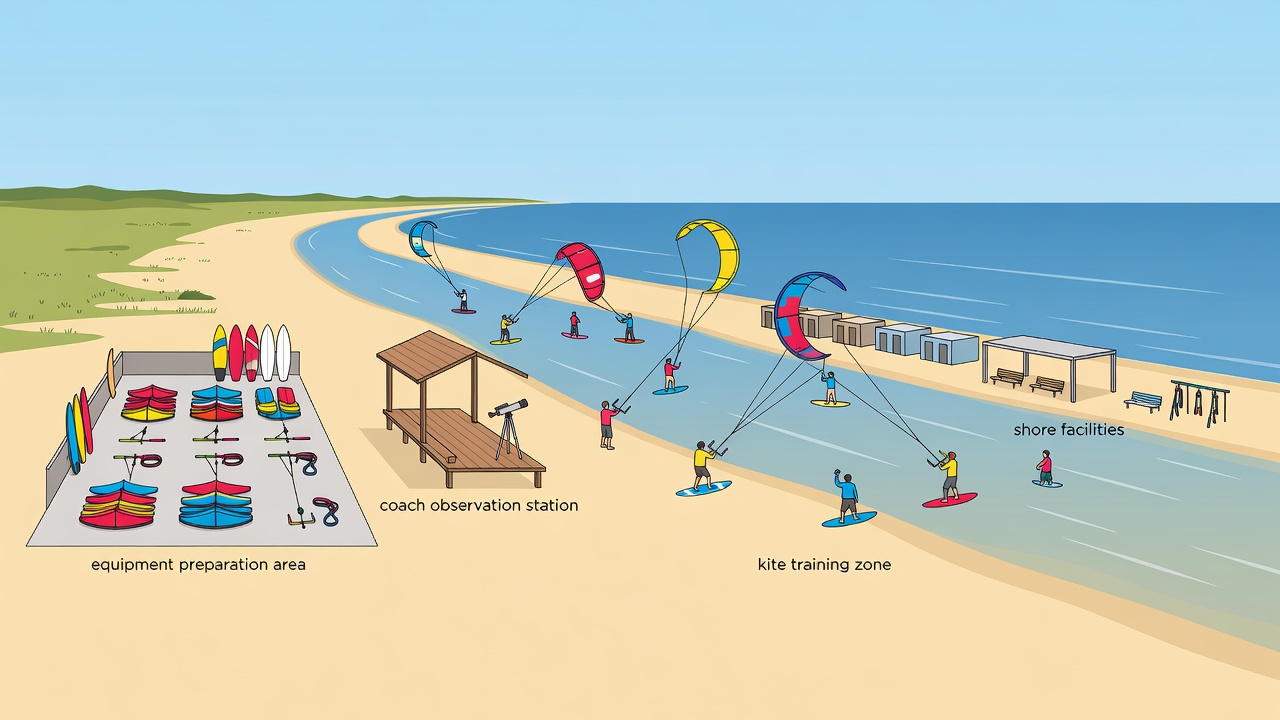
Facilities matter when they reduce avoidable friction and support learning. Walk through the sequence from arrival to departure: equipment storage, preparation, briefing, water access, observation, changing, food and review. A modest base with dependable arrangements may serve a development block better than a visually impressive site with long transfers and little space to debrief.
Clarify equipment responsibilities. Ask what is included, how faults are reported, who authorises repairs and what happens if a suitable replacement is unavailable. For athletes travelling with their own equipment, secure storage and drying arrangements can affect the working day. Do not assume that a general rental fleet meets the requirements of a competition-focused programme.
- AccessExact location, permissions, transport and competing uses.
- PreparationSuitable space, equipment checks and clear responsibilities.
- ContinuityAlternative sessions, maintenance and communication.
Ask about the day that does not work
A training environment reveals its quality when the original plan becomes unsuitable. Ask what happens during insufficient wind, excessive conditions, restricted access or a coach’s absence. Useful alternatives might include supervised review, relevant physical preparation, equipment knowledge or event planning. They should serve a learning purpose rather than merely fill time.
Also request the commercial answer. Understand whether the booking purchases coaching availability, a fixed number of sessions or a package with specific cancellation terms. Ask which transfers, facility fees and alternative activities cost extra. The training explanation and the booking contract should describe the same service.
Check the support behind the shoreline
Ask about local emergency arrangements, rescue provision, coach communications and healthcare access. Request a plain-language account of responsibilities and limits, including what happens when training takes place away from the usual base. Insurance cover must be checked against the actual activity, location and competition involvement; a general travel policy may not cover every circumstance.
Weather services such as Germany’s Deutscher Wetterdienst and Spain’s Agencia Estatal de Meteorología provide official meteorological information. They do not replace an academy’s local assessment or individual supervision. Families and athletes should understand where forecasts enter the decision process, without being expected to make technical participation decisions alone.
Finish with a simple test: can the programme explain how its setting supports the next learning block, and can it explain what happens when that setting is unsuitable? Clear limits are evidence of a thoughtful system, not a weakness to be hidden.